Sunday, June 23, 2019

#620 Swainson's Warbler in O-H-I-O

"Hang on Sloopy, Sloopy hang on
Hang on Sloopy, Sloopy hang on
Sloopy lives in a very bad part of town
And everybody yeah, tries to put my Sloopy down
Sloopy I don't care, what your daddy do
Cause you know Sloopy, girl, I'm in love with you
 And so I sing out" -- The McCoys, 1965

My Sloopy bird for the year finally showed up here in Ohio. After birding most my entire life, I've seen a lot of birds. Almost every year, I can count on Ohio bringing a life bird my way. What a great state!!

2018--Iceland Gull 2017--Calliope Hummer & Long-tailed Jeager  2016--Curlew Sandpiper  2015--Brambling & Black-headed Gull  2014--Northern Wheater


so now was does 2019 have for me?!?

Swainson's Warbler, male

#620

Limnothlypis swainsonii


A heavyset warbler of southern swamps and forested ravines, the Swainson’s Warbler has a bold, ringing song but tends to remain frustratingly hidden in the understory. This brownish songbird isn’t as brilliantly colored as other warblers, but males have a subtle chestnut tone in the crown and sometimes a lemon-yellow wash below. The species forages mostly in dense vegetation on or near the ground, where it uses its hefty bill to turn over leaves in search of insects and spiders.


Back on May 13th, a local birder in the Dayton area was checking the Tecumseh trail in New Carlisle, OH . . and heard the very distinct call of a Swainsons' https://www.allaboutbirds.org/guide/Swainsons_Warbler/sounds

This young male has set up shop and the entire state of Ohio and birders afar have come to hear this bird first, then see slight glimpses, then maybe get great pictures like these. Bird was last reported June 18th, even after the Dayton Tornados on May 27th . . it survived.

7th Ohio bird reported ever on Ebird archives?  GreenLawn Cemetery 1985.

Rare for Ohio


Family history

Buddy Gambill--saw it after 1981, no exact record
Red & Louise--#650 in 1983, 85', 87'

Wow, mine was #620 and R&L was so close at #650

      
Party?

Mr. 620 Birds & 510 HP XKR Jaguar


Question:
So now that I'm at 620 ABA traditional area for life birds. What to do from here? Where to go from here?

Next Update: Plan of Bird Action to #700⇺🐦🐦

Sunday, June 2, 2019

Arizona Birds +3 lifers & 99 degrees hot


In the week after Easter, my family had not rented their villa in Scottsdale, AZ. so we decided to travel for some hot sun weather . . . and of course birds!!  Actually, this trip was a quick three day lay at the pool everyday trip.  But with the west coast time change, early to bed early to rise . . . on the road at dark, making it to Cave Creek park at sunrise for this

In the Light, Led Zeppelin

safe Selfie time


I  was at Cave Creek looking for the Bendire's Thrasher, the last of the thrashers for me. Ebird reports where three weeks old.  I did hike some trails, not to far thou. Lack of water and equipment, but two hours and I found some good Arizona birds and many first of years!!

Cave Creek Parkway/Marriott birds:
Gambels' Quail--common on grounds
Swainson's Hawk--road back CC, perched
Harris Hawk--over pool, harassed by black birds
White-winged dove
Rosy faced Lovebirds--now living at Marriott
Costa Hummer
Gila wp
Say's Phobe
Ash-throated Empdix
Verdin
Curved-billed thrasher--no Bendy's
Hooded Oriole--orange and singing
Rufus-crowned sp
Abert's Towhee--at golf course
Lovebirds

Abert's Towhee


Mt. Ord & Lake Saguaro birds:
Pied-billed Grebe
Zone-tailed Hawk--look thru the buzzards, to get a Zone-tailed!!
Spotted sp
Willet
Eurasian-collard Dove
Bells Vireo
Gray Vireo--Lifer #618
Woodhouse Scrub-Jay
N. Rough-wing Swallow
Lucy's Warber--at the lake, life bird #579 seen again!
Canyon Towhee--heard only 😹
 Black-chinned Sparrow--Lifer #617
Scott's Oriole--wow, what a pretty bird and song of the mountains.

Black-chinned sparrow #617

Gray Vireo #618


 If you hear a ping-pong ball bouncing around rugged and rocky hillsides of the Southwest, look for a Black-chinned Sparrow. These small, long-tailed sparrows are gray with a pink bill and brown wings. Only the male sports the namesake black chin. They forage on the ground in chaparral and desert scrub, but they don't stay out in the open for long. They spend winters in Mexico.
Scott's Oriole
 A small, drab bird of desert scrub, the Gray Vireo shows only faint traces of the typical vireo spectacles and wingbars. Song is a halting series of 2 to 3 note phrases with a burry quality.
Zone-tailed Hawk

Woodhouse Scrub-Jay


Buckeye, AZ-- 27033 W. Harzen Rd. birds:
Inca ground dove
Common ground dove
Ruddy ground dove--Lifer #619
20 Peacocks--exotic, non-countable, just loud
Western Kingbird

Which one is Ruddy? #619

4 species in photo, w Lifer!!

Very common in the tropics, this little dove ranges north to northern Mexico, and recently it has been showing up increasingly often in our Southwest. Ruddy Ground-Doves are appropriately named after the bright ruddy-colored plumage of the male, which makes them distinctive from males of other ground-doves.
20 or more Peacocks . . .very loud

Me down the lane getting RUGR


 For not being a birding trip, boy did I bird!!! Thank you mom for the week of sun and fun. We really enjoyed it. How about my Nissan Murano/National Car rental and prepaid gas, one full tank, back on empty, 332 miles

57 species
+3 Lifers
32 FOYS

next up: Life bird in OHIO strikes again . . . I love this state


Sunday, February 24, 2019

Minnesota Birds -23 degrees +5 Lifers


We came, we saw, we froze, and then we left!!!  It's time for another great birding adventure with gang out into the great cold & white open. In order for me to see new life birds, I have to travel to different places, different times of the year . . . so the chase was on to Minnesota.

With schedules getting booked, the best time we could visit was late January 2019. We flew from Covington, KY to MSP direct on Delta, landing at 8am CST on a Friday.  It was cold, but sunny.  After getting the rental and breakfast, we had a 2 hour drive to Duluth.


We tried for some Duluth birds, like the reported Tufted Duck, King Eider, Bohemian Waxwing & Northern Goshawk, but to no avail.  The cold had frozen the lake, so no chance of ducks.  Then we drove up & down Knife rd, but no luck with waxwings or goshawks. I only saw 9 species of birds the first day. It's cold here!  So off to the hotel for check-in and sleep, tomorrow is going to be all BOG!!

From Duluth, it's only a 30-40 min drive to the BOG, too bad it's negative 20 degrees this early in the morning.  We used the map and driving tour guide to follow. It's a great resource for any birders first time at the BOG.  Here is the link: https://saxzim.org/plan-your-visit/


Dawn at BOG

Its COLD


Starting at the Warren Nelson bog, we missed the Black Backed Woodpecker, she was there, seen by others, but I just never got to see her.  So we left and visited some feeder stations.   From there we headed up Rt 29 to the next feeder stations . . . . and finally . . . . much needed


Pine Grosbeak, #613

Female & Male PIGR

LIFE BIRDS!!! Both several Pine Grosbeaks and Sharp-tailed Grouse where patiently feeding at the stations.  Hey this map thing works.

Sharp-tailed Grouse, #612
A chicken-like bird of open prairies and parklands, the Sharp-tailed Grouse uses a wider variety of habitats than its close relatives the prairie-chickens. Short, pointed tail, white at base.

The grayish bodies of Pine Grosbeaks are decked out in pinkish reds on males and yellows on females. They easily crush seeds and nip off tree buds and needles with their thick and stubby bill. Pine Grosbeaks inhabit open spruce, fir, and pine forests as well as subalpine forests. In winter they tend to use mountain ash, maple, and ash forests with abundant seeds.


OK, got the pressure off now, two life birds, with more to come!!  Off to the visitor center now.  It was not open yet, but the feeders had several more PIGR, Common Redpoll, Pine Siskins to photo.

By now we had traveled up to ZIM rd., and where coming back south down McDavitt Rd., in hopes of hawk owl spot.  We spotted 6 cars parked on the road. Again it was COLD.  Only two cars had people in them, the other where empty. So we loaded up the gear, and started walking on this winter path east.  We finally passed some birders, who said "yea--it's there just keep walking". OK, it's COLD but we keep walking this narrow snow path. Once we made the turn, there up in a tree . . .


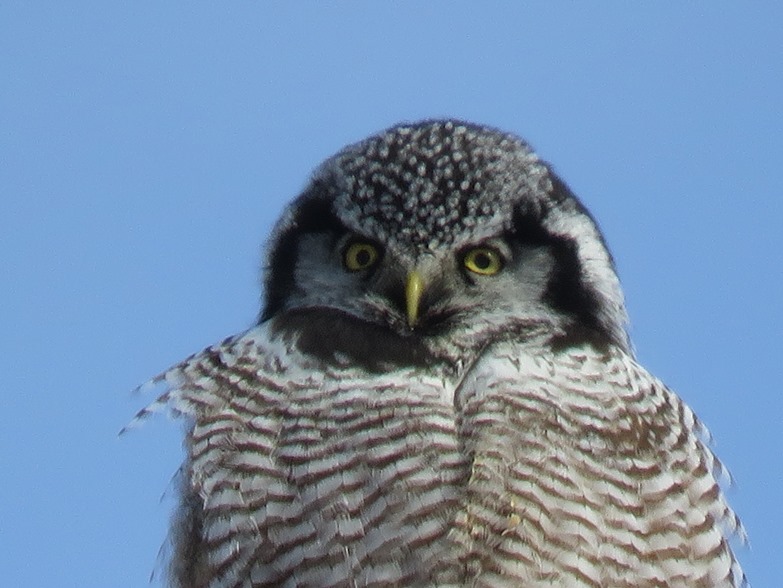
Northern Hawk Owl, #614

Hey, looky here

Lifer for ALL birders who brave

A bird of boreal forests, the Northern Hawk Owl behaves like a raptor, but looks like an owl. Its oval body, yellow eyes, and round face enclosed by dark parentheses are distinctly owl. Its long tail and habit of perching atop solitary trees and hunting by daylight, though, are reminiscent of a raptor. It is a solitary bird that tends to stick to the boreal forest, but some winters it moves south into the northern United States delighting birders near and far.

OK, WOW. What a journey, such fun to share the experience with friends and birders, but now its back to the car, because it's COLD.

Now we head down to Sax Rd., then back north on Admiral Rd. to the world famous "Admiral Feeders".  A spot that has been know of for years and most reliable for Boreal Chickadee. We pull up, and there's about 10 cars, about 30 birders, all real close to the feeding station. I walk up and ask a guy about our two target birds . . . and he points and says "yeah, they are right there" . . . .

Canada Jay, #615

Boreal Chickadee. #616

Admiral rd. feeders


The deceptively cute Canada Jay is one of the most intrepid birds in North America, living in northern forests year-round and rearing chicks in the dark of winter. Highly curious and always on the lookout for food, Canada Jays eat just about anything, from berries to small animals.

A brown-capped chickadee of the northern boreal forest, the Boreal Chickadee is one of the few birds living completely within that biome in Canada and bits of the United States. Brownish gray overall with a brown crown, small white cheek patch, and cinnamon flanks.

And with that, the life bird train came to a close.  We missed several other lifers for me, but that only give me a reason to travel the county and come back to the BOG in the future.


Evening Grosbeak

Northern Shrike

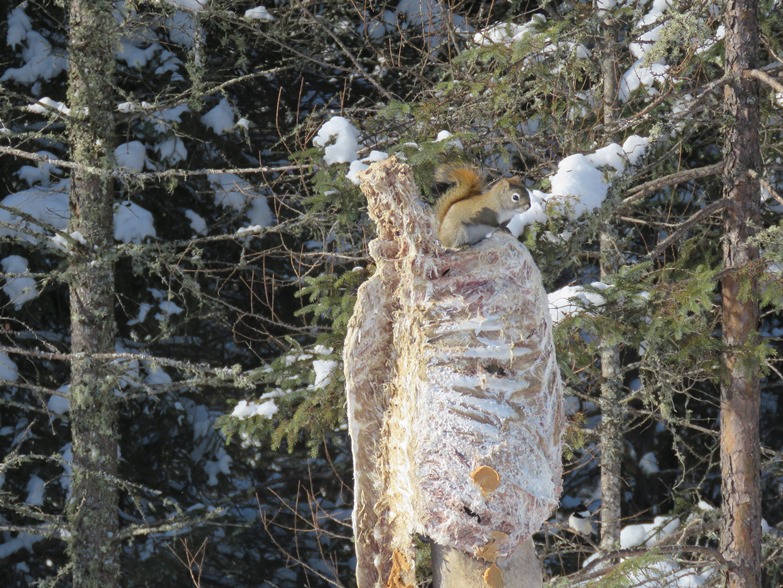
Squirrel and Rib cage meat

Mary Lou's feeding station
 Trip stats:
31 species
5 life birds
-40 degrees w wind chill
740 miles driving
Never about 0 degrees


Lifers Missed:
Black-backed Woodpecker
Bohemian Waxwing
Northern Goshawk
Hoary Redpoll
Boreal Owl


Sunday, January 6, 2019

#BigYear2018 in review

Happy New Year!!! 2019, can you believe it? Wow has the time gone by fast.  This post is a recap of the year that was #BigYear2018, all the fun stuff, places visited, good times and future plans. Below are some of the highlights.

Seattle in August for Pearl Jam & Birds


Corn Creek, NV at daybreak

2018, Team Vape May Warbler


  • 7 lifers--Wow!! I had a good year, 2017--18, 2016--12, 2015--13 new and in 2014 I had 29 lifers. I traveled to Nevada +3 in springtime and Washington +3 in summer, which produced new birds. Ohio produced +1 new lifer!! I am still thankful of the trips taken, birds seen, and friends I've been with making memories and good blog posts! Thank you all and God Bless. That puts me at #611 Life Birds.                                                                                                                    
  • My ABA Bird of the Year is . . . .the code 2 LeContes &  code 1 Sage Thrashers during my Nevada trip. None of my life birds where "rare" Code 3 or higher, so I wanted to choose these two that I've been wanting to see in a while. All the thrashers I needed where out west, so I got a reason to travel. Now, just the Bendire's Thrasher is all I need.


LeContes Thrasher #607

Sage Thrasher #608


  • My Ohio Bird of the Year is . . . .the code 1 Iceland Gull Finally I nabbed this seagull. It's been 2-3 years waiting for a cold Ohio winter to see this bird. The ABA lumped the Thayers & Iceland together, just making one countable, the Iceland Gull.  It's known as the "white-winged" gull family.  We traveled to Dayton in January and spent close up time with this guy.
Iceland Gull, Dayton Lifer #605

Some more great Ohio birds I saw.  Only 2nd time ever Harris Sparrow, and 3rd time ever Kittiwake. Finally saw the Northern Shrike here in Ohio, second time ever too.


Harris Sparrow, Newark, OH Jan.

Black-legged Kittiwake, Hoover Dam, OH


Northern Shrike in Ohio


King Rail


  • 6 states visited--Ohio(170 birds), Texas(137 birds), Nevada(+15 foys), Washington(+15 foys), Florida(+12 foys), South Carolina(+4 foys)
  • 353 total species--Finishing it strong!! I beat my average by 1 1/2 birds.  I ticked many Ohio common birds this year. This puts me at a 351.5 species per year average over 6 years. STATS.  In 2013--338; 2014--359; 2015--322; 2016--360; 2017--377; 2018--353

Salineno, Texas boarder


Kirtland Warbler, Ohio


Below is a list of some of the new first of year birds(FOYs) I saw in Ohio, during the last 45 days of birding in 2018.

#342 Black Legged Kittiwake
#343 Winter Wren
#344 Fox Sparrow                                                           
#345 Red-necked Grebe
#346 LBBG
#347 White-winged Scoter
#348 Surf Scoter
#349 Short Eared Owl
#350 Northern Shrike
#351 Black Scoter
#352 Rough-legged Hawk
#353 Sharp-shinn Hawk


**heard only 2018**
Eastern Whip-poor-will, Sandhill Crane, Yellow-billed Cuckoo, American Bittern, Bells Vireo, Sedge & Cactus Wrens, Northern Waterthrush, Kentucky warbler
 

Rarities seen in 2018--
             Code 4 Blue Bunting--male  LRGV

             Code 3  White-collard Seedeater--seen in LRGV, Texas 


White Collard Seedeater


  • Misses--many of them, especially Ohio species. I  birded OHIO, but missed some easy ones. Getting out every Sunday since May helped me see/hear them, so I'm thankful. So in 2019, my goal will be to get them early and keep trying.  Misses included: 
        Snow goose, Cackling, Tundra, Northern Pintail, Greater scaup, LTD, RT Loon, Least, Yellow-bellied & Alder empidx., Franklin's Gull, Black Tern, BlackBellied Plover Buff-breasted, White-rumped Sandpiper, Baird's SP, Long-eared Owl, Philly Vireo, Connecticut, Mourning warblers, Nelsons Sparrow, Purple Finch, Lapland LS, Snow Bunting.
 

  • 2019 trips--So far two planned trips, but likely some to follow. 
           1. January--Duluth/ZaxSimBog, MN--lifers needed about 11 birds;  Owls, grosbeaks, waxwing, 2 woodpeckers and other winter specialties 
           2. February--San Clemente, CA--birding is southern Cally again
           3. Ohio--Biggest week in American Birding--you know where to find us in May
           4. Hawaii, maybe--for 15th wedding anniversary
           5. Las Vegas--Gotta go to Vegas once a year, anytime?? 
           5. Chase a rarity. Can this be the year of a Code 4 or 5 chase??


Next up: Let's start off #BigYear2019 with a cold trip to Minnesota 


#2025 Big Year in Review

  Happy New Year!!!  2026 , can you believe it? Wow has the time gone by fast.  This post is a recap of the year that was  #BigYear2025 🐦🐦...