Sunday, June 8, 2014

Colorado Jackpot!! 12 Lifers added


  Extreme birding at its finest!!  New state, new elevations, new habitats produces new birds. So how did we end up here? The last 3 years Sam and I have visited the lower Rio Grande Valley in Texas in March, and got to do some rare bird chasing with Red & Louise Gambill. In 2013 we invited JK with us, and the birdteam was formed. It's getting harder to chase rarities in LRGV unless you winter there, so I wanted to find a place with more bang for the buck for a birding trip.  Last year I started following Big Year Birder Jay Lehman http://jaysbigyear2013.blogspot.com/ during his run through 733+2 species in a year. I noticed in May 2013, he had a great trip to Colorado, and got several first of year(FOYs) birds for him, that turned out to be many LIFE birds for me. So the location was set.
                                                  
My favorite road in the Centennial State

  This post will be of the 12 new life birds I got, while the next post will be more about the trip, locations, FOYs, and good times. I started the trip with ABA#539 Olive-Sided Flycatcher from 5/13/14 that I got on Tuesday earlier that week. Starting on Friday 5/16 til Sunday 5/18/2014 I saw;

#540 American Dipper--Morrison, CO--Bear Creek
#541 Lazuli Bunting--Red Rocks Trading Post
#542 Bullocks Oriole--Red Rocks Trading Post
#543 Black-Billed Magpie--Red Rocks Trading Post
#544 Mountain BlueBird--Waunita Lek, 20miles East of Gunnison, CO
#545 Gunnison Sage-Grouse--Waunita Lek, 20miles East of Gunnison, CO
#546 White-Tailed Ptarmigan--Loveland Pass on Route 6
#547 Townsend Solitaire--Genesee Park, Golden, CO
#548 Plumbeous Vireo--Crow Valley Campground--Briggsdale, CO
#549 Common Poorwill--Crow Valley Campground--Briggsdale, CO
#550 Cordilleran Flycathcer--Crow Valley Campground--Briggsdale, CO
#551 McCown's Longspur--Pawnee Grasslands

Let the birding begin!! We landed at 7:15am MST on Friday, and before lunch, I got the American Dipper. Ebird.org had posted a report of a nesting pair, under the pedistrian footbridge over the creek. And sure enough . . .
Dippin'


#540


Next, up to Red Rocks Park & Amphitheatre and the Trading Post. Again, Ebird.org had some nice reports from both places, so we stopped by. Plus, the actual red rocks that stick out of the ground are amazing. It is worth a visit and it's free. At the Trading Post, through the gift shop, there is a nice back yard area, with feeders, trees, water feature, and giant red rocks. Many birds fly through, so just sit back with your camera and BOOM!!  . . .

#541

Male(left) Female(right) Lazuli Bunting


#542

Male Bullock's Oriole


Then . . .                                                                       


We went over to the amphitheater to look down onto the stage, and up at Ship Rock. There had been reports of Prarie Falcon that nests up in the rock. And sure enough, we could hear the calling of the bird, but it never came out for flight. So without being 100% sure, we bounced on ticking that life bird. It will have to wait until next time. Giving me a reason--to travel the county. Down in the lower parking lot of Ship Rock, we spotted a great view a Black-Billed Magpie, one of many seen during the trip.
 
#543
 Now, we where making great time, and had seen a lot of birds. We stared southwest on the famous Route 285 from Red Rocks down to Salida, CO then west on Route 50 to Gunnison for the night. We stopped at the place for the grouse in the morning, just to see what it looked like with daylight, and if we where lucky, a sighting. No grouse that evening, but I did get my last life BlueBird species, the Mountain BlueBird. Unlike other bluebird species, Mountain Bluebirds often hover while foraging; they also pounce on their insect prey from an elevated perch

#544
The next morning, we awoke at 4am MST, for a 20 mile drive to be back at the Waunita Lek for the dawn display of the Gunnison Sage-Grouse(#545). Jay Lehman got the grouse the same time last year on May 15th. We were 2 days later, but intially had no luck. It was a large field with foothills about 2 miles away. We did not see any grouse, just the sounds of Wilson's Snipe tickling calls. A second car arrived later, an Italian birder here in the U.S. for 5 weeks. He had no idea, but wanted to see the birds too. Then, another car with Colorado plates shows up with 2 more birders, great locals, just what we need! After 15 minutes, the CO birder moves up to the front to look at the farther foothill, and he says . . "I've got the birds!!"  Great news for us. I ended up viewing 2 males far away on the foothill through the scope, but could not take any pictures. It's the only one I didn't get a snap at.      

Birding a 5am, it's a regular thing

Yeah!! LifeBird for #TSB


Wow, that was LUUCKY, almost dipped on that one. With that adventure over with, we headed back to Roadway Inn for free Continental breakfast. The owner was very nice, and happy we had seen the bird, many birders come and stay at the Roadway Inn just for this spectacle.  With that we decided to head back up route 285, then north on route 9(see first pic) through Breckenridge, then east onto route 6 to Loveland Pass. Here we are at 12,000 feet, and there's snow everywhere on the pass. It wasn't too cold, but windy, and a very sunny day.  Many reports on Ebirg.org and from Jay's big year blog, that this IS the place to see . . .


#546 White-tailed Ptargiman

Male(bottom) Female(top)


Holy crap, we just got two Code 2 birds the same day. This is the reason we came to Colorado!!!  Now what??  We where still a couple of hours ahead of schedule, so we refereed to Jay's blog again. He had mentioned stopping at a place on the way back to Denver off I-70. So we decide to stop at Golden, CO at Genesee Park. We dropped down a dirt road, into the park, and went all the way down to the last parking area. We got out and walked down the path, but didn't get too much, a Broad-Tailed Humming bird was very neat, and lifer for Sammy and JK. Back at the car area, we saw this mockingbird type bird, but they don't have mockingbirds at this elevation.  Closer look, white eye-ring, buffy wing patch, long tail . . BAM . . . a Townsend's Solitaire
#547 Towsend's Solitaire


What a neat bird, this was another lucky tick. There had been no good reports of this bird, and we where not even suppose to stop here. Turns out, this location was good for Pygmy Nuthatch and Mountain Chickadees too.  So that was it for day 2; 3 more great life birds, including those Code 2s. We stayed the night in Brighton, CO for an early drive to the Pawnee Grasslands.
  The initial plan was to visit the grasslands just for one bird, the McCown's Longspur, which should be an automatic there. But during the weeks that lead up to our trip, a new place popped near the entrance. Migration was still moving in Colorado, and the Crow Valley Campground gained fame this spring with a Painted Redstart from 5/1-5/3. Turns out, this middle of nowhere campground is really great for birding, lots of warblers, tanagers, and empidx. There is a creek/stream that runs through, and the water was high, but a lot of birds where around it. Including this . . .

Plumbeous Vireo
#548


In 1997, ABA split the Solitary Vireo into three species, the Blue-Headed(East); the Plumbeous(Rockies); the Cassin's(West). Since I get Blue-Headed in Ohio each spring, that just leaves the Cassin's left for  lifer. Next thing we know, where walking around a camp site, and a guy comes up to us and says, "Hey, don't go further this way, there's a . . .

Common Poorwill
Camouflage #549

Common Poorwill


                            Again, holy crap!!! Never thought I would see this bird, didn't even know I need this as a life bird, totally unexpected. Now it's smiley time:) They don't call them Goatsuckers for nothing. On the way back to the car, we decided to walk to the beginning part of the trail, and got Western Tanager, Black-Headed Grosbeak, and this empidx. . .

Cordilleran Flycatcher
#550
                   
Found mostly east of the Sierra Nevada and Cascade mountain ranges, the Cordilleran Flycatcher is a common small yellowish flycatcher of shaded forests. Nearly identical in appearance to the Pacific-slope Flycatcher, the two forms were formerly considered to be the same species, known as the "Western Flycatcher." Split in 1990.

I saw the "Western" in 1986 at the ABA convention in Arizona with Red&Louise. I consider that the Pacific-Slope Flycatcher split seen now. So that leaves just one bird left, and the only one we came here to see . ! . ! .

McCown's Longspur
Best pic, Male in breeding plumage

#551
And this was the only ONE that we saw, just a couple of seconds on the Pawnee Grassland's road to no where. We probably could of chased further around looking for more, but as the Lucky Gambill motto says "One Bird, One Time"


So with that concludes the winning 12 numbers in tonight's Colorado Bird Lottery, please tune in to later posts for trip round up.

Next Up: Colorado in 60 hours, and 778 miles


Sunday, May 25, 2014

24 Hrs of Birding


We came, we saw, we kicked it's ass!! A little friendly competition we started here last year.  You see, for the last couple of years, the Cornell Lab of Ornithology has had a team that does a BIG DAY every year. In the name of conversation, a team of 5 members have raced around a 400-500 mile triangle in south eastern Texas to try and see as many species in 24 hours. Sun up to sun set. They have set some great records and seen some really neat birds during spring migration. In fact, they got 264 in 2011 and 294 total species in 2013--an all time best record. So it got me to thinking.

What if we had a team, that drove around like crazy, walked miles through parks and paths, and birded all day. And the idea was born.

#TSB 2014
24 hours of birding!! Last year, me and my friends Sam and JK went up to Magee Marsh during http://biggestweekinamericanbirding.com/ in May, and got 94 total species. We where known as Team Dickcissel in 2013. This year, new name, new locations and new birds for Team Snow Blunting(TSB)!! We even had custom T-shirts made.
   Since we live in Columbus, we decided to start our 24 hour clock on Monday May12th at 2pm, at Big Island Wildlife area, then north to Killdeer plains. We extended our range this year to cover more areas during the birding timeframe. We added great new birds this year at Big Island like Common Gallinule, Sora rail, Bald Eagle, Bobolink and Ring-Necked Pheasant. At Killdeer we got Dunlin, Short-Billed Dowichter, Trumpeter Swans, and Brown Thrasher. We ended up with 61 total species for the first day, and headed to Freemont Travelodge to spend the night.


Male Ring-Necked Pheasant

Dunlin(black belly) & Long-Billed Dowichter


Sunrise on Lake Erie


We left Freemont at 6am for traditional breakfast at McDonald's and headed up SR19 north to SR2. Once you see the sun come up and the nuclear cooling tower on the right, make a left on SR 2, and a couple miles done on your right is entrance to Magee Marsh. We always try to start at 7am in the west parking lot/entrance to the boardwalk. That is where the team picture was taken above. You just walk and take your time as you make your way across the boardwalk. It is truly a magical moment and deserves to be experienced at least once in your life. Magee Marsh is one of the best places to witness migration. The birds are so close to you, 10-30 feet away at most.
Magee Boardwalk


Because of technology, it makes it even better and funner to attend the Biggest Week. On Twitter, just follow @biggestweek and @ONWRA and fellow birders tweet what bird they just saw, and what number on the boardwalk they saw it. So you can be at the beginning of the boardwalk at #1 and get a tweet that an Olive-Sided Flycatcher is at #7 on the boardwalk. So you briskly walk down to #7, then there up in a tree . . .

Olive-Sided Flycatcher Lifer #539
This was the last easy ABA code 1, of eastern flycatchers that I had never seen before. I think it's because in the last 20 years, their range has increased more commonly in to Ohio during migration. Wow, what a bird and what a great day to bird.
TSB actually had a flycatcher sweep that day of Acadian, Alder, Willow, Least, Yellow-Belly, E. Wood Pewee, E Phoebe, Great Crested, E. Kingbird and the Olive-Sided. First time ever!! I think that's because we visited a week later this year. So more birds had shown up.

Eastern Screech Owl(gray morph)

Sleeping Common Nighthawk


We didn't get a lot of warbler pictures because the birds move so fast, and are too close at times. The team ended up with 21 warbler species including good ones like Ovenbird, N. Waterthrush, Mourning, Hooded, Cape May, Blackburnian, Blackpoll, Black-throated Blue female, Canada and Wilson's Warblers.

Male Bay-Breasted Warbler

Male Chestnut-Sided Warbler


We spotted other first of year(FOYs) birds at Magee, Ottawa NWR auto tour, Metzger Marsh and the Boss Unit. Those birds included Yellow & Black-Billed Cuckoos(lifer for Sam&JK), Osprey, American Woodcock, Black Necked Stilts, Henslow's--Swamp--& Lincoln Sparrows.

Male Henslow's Sparrow

Brad w/ Jay Lehman
At the end of 2pm on Tues, back at the Magee boarwalk, we where winding down, and looking for a reported female Golden-Winged Warbler, when we spotted the rare birder, the great Jay Lehman, retiree from Cincinnati, that just completed a big year in 2013. Just like the movie, The Big Year(2011), Jay drove, flew, boated and walked around the entire ABA area all year, and finished at the 4th place of all time Big Years with 733 + 2 provisional species. WOW!! Holy cow. Jay in one of only 14 birders that have ever seen over 700 species in a calendar year.  Check out his blog at http://jaysbigyear2013.blogspot.com/.  Jay has been birding a long time, and has meet/birded with my grandparent Red&Louise in south Texas, and my father Buddy the artist. So yet again, another reason for me to do this blog, to connect the past with the present and to fulfill the Gambill journey.

Jay Lehman actually inspired TSB from his big year. Our team decided to go to Colorado in middle May 2014 to "Retrace the Steps" that Jay did last year. From his blog, we created a great itinerary to bird as hard and fast as we could in 60 hours in Colorado. More about our Colorado trip next blog.

Team Snow Blunting ended the 24 hours of Birding with 120 total species seen/heard by at least 2 members, from 2pm Monday to 2pm Tues. I got 1 lifer and Sam/JK got 2 lifers on this trip. Now at the end of the day, we where exhuasted.

Next up:  Colorado or Bust!! Lifer, lifers, lifers . . .

Thursday, May 22, 2014

Spring Migration is here

Well, it's about that time. After mid April, the early spring migration starts here in Columbus. It is a great chance to get out and see the flowers blooming and many different species of warblers start coming back from down south. 

Common Blue Bell
There are several great spots to visit on the north east side of Columbus.  Woodside Green Park in Gahanna is great. It is located along the Big Walnut Creek, which feeds into the Scioto River. It also connects Academy Park on the east side of the creek. You can park and walk right onto the path, cross the creek and back in less than 30 minutes. 


Hyacinthoides non-scripta is a bulbous perennial plant, found in Atlantic areas from north-western Spain to the British Isles, and also frequently used as a garden plant. It is known in English as the common bluebell or simply bluebell. In spring, H. non-scripta produces a nodding, one-sided inflorescence of 5–12 tubular, sweet-scented violet–blue flowers, with strongly recurved tepals, and 3–6 long, linear, basal leaves.

Some of the birds you can get at Woodside Creek include the Northern Parula, Yellow-Throated Warbler, Blue-Headed & Yellow-Throated Vireos.  But what about this guy??  Your local Barred Owl family.  Both male and female live in the woods, and can be seen off the path. Just listen for the hoots, or if the crows are around, they will be harassing the family often.

Barred Owl
This is a picture of the female Barred Owl. It has a pale face with dark rings around the eyes, a yellow beak and brown eyes. It is the only typical owl of the eastern United States which has brown eyes; all others have yellow eyes. The upper parts are mottled gray-brown. The underparts are light with markings; the chest is barred horizontally while the belly is streaked vertically. The legs and feet are covered in feathers up to the talons.[3] The head is round and lacks ear tufts, a distinction from the slightly smaller Short-eared Owl, which favors more open, marginal habitats.

 Another great place to visit in late April is North Hoover Reservoir Boardwalk and Area N.  Last year, Columbus Audubon did a bird walk there, so on the same weekend in 2014, I decided to visit to see if I could see the same birds. Sure enough, like clockwork, the early migrants where there.  Since the boardwalk was closed for repairs, Area N next to it is best. It is just like swamp thing, a low marshy area with standing water and large trees. This location is best know for the Prothonotary Warbler nesting sites/boxes. Fellow CA member Charlie Bombaci leads the annaul project of putting up over 200 nesting boxes for this species, and the results in over 185 pairs of Prothonotary Warbles both in boxes and natural nesting sites.


Male Prothonotary Warbler

 The Prothonotary Warbler has an olive back with blue-grey wings and tail, yellow underparts, a relatively long pointed bill and black legs. The adult male has a bright orange-yellow head. Females and immature birds are duller and have a yellow head. In flight from below, the short, wide tail has a distinctive two-toned pattern, white at the base and dark at the tip. It breeds in hardwood swamps in extreme southeastern Ontario and eastern United States. It winters in the West Indies, Central America and northern South America.  It is the only eastern warbler that nests in natural or artificial cavities, sometimes using old Downy Woodpecker holes. The male often builds several incomplete, unused nests in his territory; the female builds the real nest. It lays 3–7 eggs. The preferred foraging habitat is dense, woody streams, where the Prothonotary Warbler forages actively in low foliage, mainly for insects and snails. The song of this bird is a simple, loud, ringing sweet-sweet-sweet-sweet-sweet.
Other good birds to see at Area N are the Warbling Vireo, Red-Headed Woodpecker, Northern Parula and Yellow-Throated Warbler.  So stop by north Hoover/Galena boardwalk next time. Just watch out for the local fishermen.

Next up:  24 Hours of Birding!!

Tuesday, April 29, 2014

The Sunshine State

 Welcome back home, Florida was very good to me. My wife and I had scheduled an adult spring break trip, Mach 24-31st. We were meeting up with 2 other couples to enjoy a sunny week in south Florida. I got the chance to meet up with #TSB member JK and do some extreme birding for 3 days, starting at 6am everyday.
  From my Florida Jackpot post, I wanted to share the story about the North Cape Corl area where we saw the Florida-Scrub Jay. It was on NW 25th Terrace, north of Kismet Pkwy.
When we pulled into the area, the houses went away, and just the
Life Bird spot
 over grown road and openness surrounds. It was around 9am, and the perfect habit for Scrub Jays. We saw 2 or 3 just on this street. It was quiet, but had a tranquillity to it, just the sound of Eastern Meadow Larks calling. http://www.allaboutbirds.org/guide/Eastern_Meadowlark/sounds  What is this place?


After 2 hours and 2 life birds, we decided to drive over to Sanibel Isand. On the causeway on the way over, JK reported a Frigate Bird that he saw two day earlier. Sure enough, I got to see the Frigate soaring on the north side. I even pulled over on the island spot and got the binoculars on him. My records show that I saw the Frigate as a life bird in June 1990 while on that great run toward #500ABA with my grandparents. I'll have to add a seperate post on that trip in the future.The stories, the birds.

The J. N. "Ding" Darling National Wildlife Refuge is located on the subtropical barrier island of Sanibel in the Gulf of Mexico. The refuge is part of the largest undeveloped mangrove ecosystem in the United States. It is world famous for its spectacular migratory bird population. There is a 4 mile stretch that you can drive or bike through all day. The fee is $5 a car. $1 per biker or hiker.
We drove the Mazda 2 through, with several stops. Black Simmers, Semi-Palmated Polver, Osprey's fishing over the car. We stopped at Shell Mound Trail and tried for White-Crowned Pigeon, but no pigeons where around. We drove down to Tarpon Bay Rd, and walked out on the beach. There are reports of Snowy Plovers all along the beach from the light house down here too. No luck, there was too many people already enjoying the beach. But the Frigate Bird soared over again!
Snowy Plovers? Just Black-Bellied

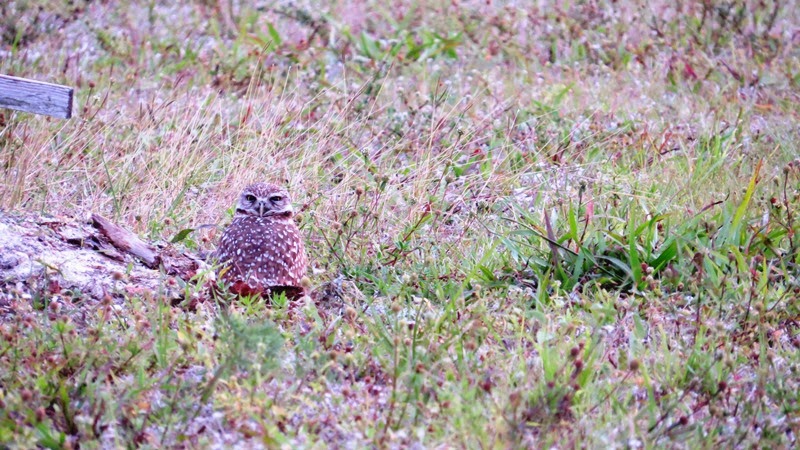
Day 2 started out with another 50 minute drive, this time south to Marco Island. This trip was inspired by http://bikingforbirds.blogspot.com/ and Dorian's adventure there earlier in March. While we waited for the gates to open at 8am, we where treated to the hometown population of Burrowing Owls. I did not realize you could see them in south Florida. I had always seen them in south Texas, Azrizon 1985(lifer) and on vacation in Aruba, yes they have Burrowing Owls too.
What's up dude?
Tiger Trail Beach. Wow. The goal here was again Snowy Plover, a lifer, plus Semi-Palm, Piping, Wilson's, Black-Bellied. We did not get a chance to go all the way out. The wind conditions where not good, and we where not prepared to walk through shin high water toward the beach. See the photo.  Instead we did the LONG walk around to the right, then left to the red line. We got to the start point, and birded there back into the lagoon area. We picked up several shorebirds with highlights Piping Plover, Marbled Godwit and Western Sandpiper(did not get in 2013). 
 The good news is, we know the Snowy Plover is there, so next time with good equipment, I should be able to pull a Penta-Plover day.
Day 2 ended with many FOY birds, and only one morning left for #TSB. JK was leaving at 3pm, and really wanted to get a Snail Kite. One had been reported at Harns Marsh, north of the airport. We arrived at sun rise again, and I got many FOYs like Black-Crown Night Heron, SandHill Crane, heard Northern Paula, Carolina&House wren. On our way back toward the car, from the north end. There@! Soaring low over the marsh, a female/immature Snail Kite. It move right past us, showing the hooked bill and white rump on top of the tail. It landed in a tree, and we watch it a longer with bincos until the crows pushed it on.
After we checked out, the party headed east toward Pompano Beach, FL. We had 4 nights at a private bungalow right on the A1A inlet.  I planned to do some east coast birding, with possible 3 more new life birds I could get(which I did). That Friday morning, I drove up to Green Cay Wetlands in Palm Beach county. 
This place is very famous for birders and walkers. 

I headed towards the east, and walking the entire loop just once. Toward the back hammock, I got the Sora, Purple Swamphen(lifer#535) and Yellow-Crown Night Heron. On the way out, stop by the two feeders hanging in the trees before the entrance. A fellow birder pointed them out to me, and I got White-Winged Dove and Painted Bunting, male. Sorry no pic's.


Turns out, there is another fantastic birding place 2.2 miles away that I never new about. Its called
Wakodahatchee Wetlands. The park was created on 50 acres of unused utility land, and transformed into a recreation wetlands open to the public.The three-quarter mile boardwalk that crosses between open water pond areas, emergent marsh areas, shallow shelves, and islands with shrubs and snags to foster nesting and roosting. There where lots of great species here, but most noted is a singe NeoTropic Cormorant. It has been roosting here for three years now. Typically I see this species in south Texas, but this is rare for Florida. They believe the bird was blown over here with a storm, and has just stayed with is Double Crested Cormorant friends, there his framily. Click to
enlarge the picture. Notice the longer tail, white facial marks and smaller bird.
NeoTropic(L) DoubleCrested(R)
Fulvous Whistling Ducks
What bird is that?

So, on the way to the airport to leave on the 31st. I mentioned that Wakadahatchee was on the way north, so maybe we can stop and get the NeoTropic Corm, and maybe another FOY. Luckily we did, and I saw this small, discrete bird. What is it? I only heard them last year in Las Vegas, but it was my last one to compete the Ardeidae family. Well, I saw it this year, and I'm close again. 
On the way out, in the parking lot. Swoosh, a American Kestrel lands on a tree branch. A new trip bird, then out of now where . . a Monk Parakeet flies by and lands too?!? Sorry no pics, they flew. So I got 4 new FOYs, and a great picture on that second time around. Note to self--Always try, try again. 
In conclusion, Florida was very very good to me . I'd like to thank my wife and friends for a spring break trip I'll never forget. To always having fun and living life. 

  • 7 nights/8 days
  • 860 miles driven
  • 6 Life Birds
  • 106 total species
  • 75 FOYs

Next up: Spring Migration in CBus

Sunday, April 13, 2014

Florida Jackpot, 6 Lifers added!!

Who knew vacation would take so much out of you!?! Back from a full week in south Florida
  •  over 800 miles driven, 31 MPG average
  • staying on both coasts, Bonita Springs & Pompano Beach
  • wake up everyday at 6am
  • stop to bird the same place again on the way to the airport to leave(it paid off, big-time)
Mazda2 100hp


There was so much to the trip, that my next post will be about highlights from the week. This post is only about my 6 life birds I got on the trip, which was my main goal. Wow did it payoff.

Tuesday morning, the mail goal was for 2 life birds that day. First we arrived in North Ft. Myers looking for the newly added ABA species, the Nanday Parakeet. We drove around between two spots reported on ebird.org. Usually these parakeets are farther north in Sarasota, St. Pete, Clearwater areas.

Birds on a wire
Over an hour later, we where ready to leave and give up, we went back to the 2nd spot one last time(2400 Kennesaw St), and team member JK heard the squwak of a parakeet. Bam, look up and guess who's sitting on the wire? Nanday Parakeet. As of November 2012, this is now a countable species for ABA
Life Bird #533

Nanday Parakeet
They feed on vegetable matter, live oak, acorns, magnolia blossoms & seeds, sea-oats and grass seeds, and commercial bird seed.


Whoo, almost blew that one. Glad we got the parakeets, but now onto North Cape Coral. We crossed the bridge north, then up to Littleton Rd & Kismet Parkway west. Welcome to NW 25th Terrace. Like a scene right out of Full Metal Jacket, sniper scene. It's all calm and quiet. There are no houses in this neighborhood. Only grass grown over streets, telephone poles with wires, and a couple of trees. No humans. Just the wind and the sounds of Eastern Meadowlarks calling. Very eerie. But right on schedule, sitting on the wire is a large Florida Scrub Jay.

Life Bird #534
In 1998, the ABA split the Scrub Jay
Florida Scrub Jay
into three different species, which vary by location. Now you have the most common Western Scrub Jay, seen in 9 western states. I saw one last year in Calif. Then you have a  Florida Scrub Jay(lifer!)-a code 2 bird only in certain areas in Florida. Then the hardest one, Island Scrub Jay-a code 2, only seen on Santa Cruz Island, in southern California. I mean, you have to take a boat to see a jay. Funny. Someday I'll take that boat ride and scrub jay out.
He's scrubbing


That was it for the first day not bad+2. The second morning we went to Marco Island, and the dreaded Tiger Trail Beach. The goal was for a lifer, Snowy Plover, but it was not meant to be. We were not prepared with the right equipment and enough time to try shorebird hunting that day. See Biking for Birds blog on Tiger Trail Beach. http://bikingforbirds.blogspot.com/2014/03/day-67-111-miles-and-few-new-birds.html Maybe next time, "giving us a reason  . . . to travel the country"  Ed Vedder quote.
   Team SnowBlunting member JK took off back to Ohio on Thurs, while I had four more nights on the east coast of Florida, based in Pompano Beach. Friday the 28th was a great FOY bird day, and one surprising lifer.
    Green Cay wetlands is the place to be, epically if your a walker. It is Palm Beach counties newest nature center, with over 100 acres of wetlands, and a 1.5 mile boardwalk. See, mall walkers and birders have something in common . . . we walk!! The nature is so close here, great for beginners or photography people. Coming out of the back Hammock, after I see a Sora rail, I see this larger bird, different colors. Turns out to be the Purple Swamphen, code 2, lifer!! I had planned to try another
Life Bird #535

location later to see this bird, but turns out a pair have nested here
 at Green Cay the last two years. Lucky for me again. This bird
 was another exotic that has been in Florida for years, but was
 not added to ABA listing until 2013.
Purple Swamp Hen


Saturday the 29th was a day I'll never forget. I convinced the wife to wake up at 6am, and head with me south to Miami. First stop was to see the White-Winged Parakeet, code 2, Lifer #536. I saw this parakeet on 6/26/90 in Kendall, FL with Red&Louise. Back then it was called a Canary-Winged Parakeet, and was non-countable exotic. This was the only life bird I did not get a picture of. Then on to Matheson Hammock Park, near Coral Gables, to see a rare code 3 lifer, called the La Sagra's Flycatcher. It is a tyrant flycatcher that breeds in Cuba, Bahamas and Grand Cayman. It is a causal vagrant to south Florida.

Life Bird #537
 This bird is identified by it's "wink, wink" call. And that is exactly what I heard from the parking lot. I ran over to see the bird behind the pond calling. I got some great pictures. I forgot to record some audio though. Then I heard a second "wink, wink", What? A second La Sagra's? No, it is birding guide Carlos Sanchez playing his recording, and he has two birders with him that need it too as a life bird.

They where a nice couple from West Virgina. It turns out, they had visited Uncle Mikes house in the winter for the 3 winter birds. See my blogpost from 1/11/14. Uncle Mike ended up with over 600 birders, from 5 states visit them this past winter. Then I tell them that I am Red&Louise's grandson, and they say "we know R&L, we've birded with them in south Texas."  Bingo, another deja vu moment in my life, of why I am doing this blog. Retracing the Steps of my dad's and grandparents' life and all the birds and people they've meet. Now I get to fulfill that journey. 

My records show that Red&Louise got the La Sagra's only once, 6/26/92 in Sugar Loaf Key, FL bird #766. My records of Buddy do not show that he ever saw the flycatcher, but I will cross check another data source.

Life Bird #538
My last life bird, was the elusive Oriole. I would like to thank ebird.org and my Green Mountian Digital phone app, Audubon Guides for helping me locate this one. On Sunday 30th early morning, I drove down to Wilton Manors, FL and checked on some neighborhoods where it had been reported.
It rained the night before, so I knew
the birds would be out slowly
hangin' like an Oriole
and trying to dry off. Again,
Spot-Breasted Oriole
after over an hour driving around, and getting ready to leave, I hear an Oriole type
call. Similar to Baltimore we
get in Ohio. I look up into a palm, and there it is, a
Spot-Breasted Oriole, Code2, lifer #538. It stayed put a while and I got lots of pictures. Then a second one show up, hangin' upside down. Later the male flies into a closer tree and I got the best pictures. You can see the spot-breasted and white wing bars.

So that was it folks, show's over. 8 days, 7 nights, 800 miles got me 106 total species, 75FOYs, 6 Lifers for #Florida2014. Yes, there was life bird dancing.

Next post:  Florida shines again


#2025 Big Year in Review

  Happy New Year!!!  2026 , can you believe it? Wow has the time gone by fast.  This post is a recap of the year that was  #BigYear2025 🐦🐦...