Tuesday, August 26, 2014

That's not a BIG Gull, it's a . . .

LITTLE GULL!!!  A rare Code 3 gull has shown up here in Columbus at Alum Creek State Park beach area on August 19th. I stopped by at 8am on Wends 20th, and got these great pics.

Little Gull  Larus minutus
The first sighting was on August 15th at Buck Creek SP near Springfield, OH. But then it disappeared for two days, next thing you know, there is a sighting of a Little Gull at Alum Creek. I think it is the same bird that flew some 50 miles over to central Ohio.

black spot behind eye, black bill

Chillin at beach


Some fun Little Gull facts:
The smallest gull in the world, the Little Gull is common across Eurasia. A few pairs have been nesting in North America since the 1960s, and the species is now a rare, but regular, visitor to the East Coast and the Great Lakes. In North America the Little Gull is most frequently observed during winter and on migration in groups of one to three, usually associated with larger flocks of Bonaparte's Gulls. A Little Gull chick banded in Sweden was found dead on the road in Pennsylvania in its first summer(Wow!!! World traveler). Breeds in shallow, freshwater wetlands, such as marshes. Winters along coasts, large lakes, and rivers.

only 11" in size, diagnostic red legs

Hangin with Ring-billed gulls


This was only my 2nd time ever seeing a Little Gull, my first was 2/4/1989 at the Lake Erie shores, where most gulls are in the dead of winter. I am very happy to get the bird, in the summer, in my hometown, and great pictures!!
Looking at the family archives, Red&Louise have seen the bird only a few times, but every year from 1982 to 1986 and again in 1991. Probably all Ohio records at Lake Erie.  My father Buddy first saw a Little Gull on Nov 17, 1978 in Huron, Ohio-- again probably by the lake.

This puts my #BIGYEAR2014 number at #303 for the year!!

Next up:  Viva Las Vegas!!! Birding with John Taylor at Henderson Bird Preserve. My target is 15 new FOYs and maybe a lifer . . . the Lucy's Warbler


Saturday, August 9, 2014

Life Bird Dance time!!

Just when I thought things were slowing up in middle of summer . . . a bird sighting comes along and pulls me back in!!  And where do you go in central Ohio to see a vase array of different birds?? Well the Battelle Darby Metro Park-- Teal Trail/Harrier Loop. This place can either be the death of you, or the life that pumps energy back into you. Why? Because you can go and walk the 1.5 mile loop and get zero, or you can go and get a wide variety of species. From sparrows to wrens to owls to waterfowl and shorebirds.  I've seen great ones at Battelle Darby like Blue Grosebeak, Buff-Breasted Sandpiper, Red Phalaorope, and Short-Eared Owls.

Your Tombstone


The early morning of August 6th, I arrived at the grain elevator parking lot, opened the doors, and heard the very distinct call of this . . . . Sedge Wren(ABA lifer #553)


A small, secretive wren that breeds in short grass and sedge marshes. Perhaps because of the highly transitory nature of its nesting habitats, the Sedge Wren moves around a great deal from year to year, not staying in one place for long.
The Sedge Wren is one of the most nomadic territorial birds in North America. On a given area, it may be present in numbers in one year, and be completely absent the next.

Opened the door with a smile, I hear you Sedge Wren Lifer!!

So when you go to the Teal Trail, the Sedge Wren is out in the open grass fields, right from the parking lot, you can hear and see this one. I walked the trail to left(backwards loop) and heard a second Sedge Wren calling between the west loop and the main road, looking at the entrance sign to the visitor center. Once I walked back towards the marsh areas on the loop, I heard and saw several Marsh Wrens, an FOY bird. Sorry no pictures of them, moving too fast for my camera focus.
With the Teal Trail done, I headed over to Kuhlwein Rd. south parking lot, and took out the mountain bike. Time for some biking for birds. I rode the Darby Creek metro trail north, crossed the road, turned right at the horse barns, and rode back the training loop. I needed to get two species of sparrows, both reported there, but no luck. On the ride back near the barn, guess who rests on the telephone wire???

Belted Kingfisher

Bigger are Barn Swallows, the smaller are

Bank Swallows!! FOY#300 bird
And since I took a picture of a RED bird(Summer Tanager), I had to take a picture of a BLUE bird . . .
Indigo Bunting

Notes or phrases are often repeated in pairs: "what! what! where? where? see it! see it!"


So that wrapped up a great Wednesday morning birding adventure. 33 total/3FOYs/1Life.

Next up: More Ohio FOYS please!!!

Sunday, August 3, 2014

Summer Tanager Time

Well, here we are again, in the middle of summer, and not a lot of birding going on here in Ohio. The weather has been cooler the last two weeks, which has been nice. But now we are in the hot summer month of August.

I've made a list of 37 available Ohio species I can get before the end of the year. Now it's just about getting out and ticking down these birds. I have not seen either species of Tanager's this year, can you believe that? So with the help of ebrig.org, on July 20th at Horns Hill Park in Newark, Ohio, I was able to pinpoint a location for reliable Summer Tanager, and guess what? . . .

Male Summer Tanager


BANG.

Is that a Cardinal that sounds like a Robin???

Just ate a wasp
The only completely red bird in North America, the strawberry-colored male Summer Tanager is an eye-catching sight against the green leaves of the forest canopy. The mustard-yellow female is harder to spot, though both sexes have a very distinctive chuckling call note. Fairly common during the summer, these birds migrate as far as the middle of South America each winter. All year long they specialize in catching bees and wasps on the wing, somehow avoiding being stung by their catches. (Notice the bug limbs in his mouth).


Beautiful back shot
The oldest Summer Tanager on record was at least 7 years, 11 months old when it was captured and released by a Texas bird bander in 1986


So, there goes another one, now if I can just find that Scarlet Tanager, I'd be set. How funny, I saw a Western Tanager in Colorado in May, before either Ohio species.

Next up:  I need Ohio FOYs!!!

Monday, July 21, 2014

Old Gray

I want to dedicate this post to my father, Charles "Buddy" Gambill. After going through a lot of artwork, books, pictures, etc., I wanted to share this letter that he wrote, about his birding buddy.
My cometary in red.

Having a good birding companion makes this pastime more enjoyable. Normally this companion shares the pure excitement, enthusiasm, discovery, and the countless stories that arise from Birding, let alone someone to bird with. One constant companion for the past 14 years has been Old Gray.

Old Gray at Pickerington Ponds

Old Gray and I have seen over 600 plus birds from Texas to the East Coast, birding the plains, mountains, hills, swamps, the shorelines and the open seas. Or should I say, taken me to see these places. You see Old Gray is my car, a 1987 Chevrolet Celebrity wagon with 300,000 miles on it and still going strong.

Over the years, Old Gray has made two weekends trips to Texas, from Ohio; now this is a three-day weekend. Old Gray went once below Corpus Chrisiti for Northern Jacana(spring 1993). I went on this trip. Driving through the rains/floods in Houston on the way back, water was coming into the floorboard through the gas pedal hole, but still driving behind a Semi for wake. Once pass the deep water, later we run out of gas, Dad get's picked up, leaves me, comes back with a 5 gallon bucket with gas, and a paper funnel, wheh?!?. and a  Masked Duck with a 2-hour turn around and visit with my parents who had driven up from the Rio Grande Valley to meet us. This included the now famous find a fast food stop with a 30 minute oil change place next door so Old Gray could get juiced up on the way back. The other trip was for a Blue-footed Booby(1994. I did not go) below Austin, Texas. A two hour birding tour in the area, and then turn around and head back. If you can make Texarkana by nightfall, then it's only a 13-hour drive back to Ohio. This included a Wal-Mart stop, 30 minute oil change at the store, you can get food, travel snacks, cowboy hats, Patsy Cline's Greatest hits and Willie Nelson tapes to play on the way back, one is set ready to go, rested refueled and back behind an old friend.

She went on several trips to Maryland and North Carolina for pelagic good birds on these forays where Herald's Petrel, White-faced Storm Petrel, White-tailed Tropicbird, Kelp Gull, Black-tailed Gull, Yellow-footed Gull, Fork-tailed Flycatcher along with the regular standbys. From Ohio, Old Gray has birded Maryland, Virginia, Delaware and North Carolina extensively, totaling up states lists in these regions. Old Gray is not limited just to the states; she has seen Mexico but never ventured that far and visited Canada several times. Birds seen there on weekend trips were Variegated Flycatcher, Boreal Owl and Northern Hawk Owl, missed the Fieldfare both days.

How about a quick trip up to Michigan for the Green Viloet-eared Hummingbird with the parents? Oh, they had already seen two in Texas, but why not, we can stop on the way back at Metzger Marsh on Lake Erie in Ohio and see a Piping Plover. A two hour diversion, but Old Gray doesn't mind. She gets us there an can rest when we get home.

Not to be limited to just birding, the wagon took my son and his friends to spring break in Florida one year(1995). I'm sure a birding trip was much better wear than this, but the car stuck it out, brought them all back minus some luggage and a thermostat, which by the way I had to replace after the son broke the housing trying to replace it. This is also my work car, 6 days a week, 12 months a year, with the only reprieve when we go overseas to bird. On repairs, the key word is "lifetime", second pair of shocks for the rear, lifetime Monroe's, lifetime alignment, twice a year, 4 mufflers, replaced free, all my brakes and rotors replaced free, which is really great whenever they say you need work done. Firestone doesn't make money on Old Gray. I have replaced the DogBone engine mount 5 times, and started doing that myself, 4 batteries, 6 sets of tires, the medium range of 40/50K seem to work well. Replaced one cog(plastic) in the transmission. I change her oil every 3000 miles, and it leaks a little power steering fluid, but besides that it has been a good car.

factory publication of new wagon


Old Gray is always ready to go. Under the front seat are a pair of Bausch&Lomb Elites 8x42, old style 2nd year production, great pair of bino's, kept in leather case, important for storage and wear. Under the passenger seat an old Sportmaster spotting scope 25/60 zoom with a window mount. In the rear, 2nd edition National Geographic guide, just in case along with 3 large binders that contain all the ID guides gleaned from Birding, American Birds, Fieldnotes, Bird Watching Digest, North American Birds and various Internet sources for reference. This all at hand, one is always ready to safari. Safari(an Ohio trip) it has, a quick 2 hour trip after work to catch a Marbled Murrelet in waning light, a Violet-Green Swallow in a late evening birdwalk, a Yellow Rail again after work, the Christmas Eve run for a Say's Phoebe as I was shopping, only a 3 hour diversion. This doesn't include all the chases that panned out, hours of driving only to hear it just left, more than I want to recall. The Internet has made Old Gray work a little harder with daily/hourly updates. Out of the 331 Ohio birds Old Gray has taken me to about 325ish, on the weekends we have started using the other cars, also gray, to give the work horse a repress. I still have maybe three more years before retirement, and I'm hoping she'll take me through, after all in the other cars the binos and the spotting scopes don't fit under the seats.

If I go out today to start the old car and she doesn't start, I'll have no regrets and give her a hug for taking me to a lifetime of birding and adventures. The spot where Old Gray turned 300,000 miles was the first spot, Pickerington Ponds, that I ever birded with her back in 1987, and I think the Ring-billed Ducks and Lesser Scaups were there that day also.

Written in 2001, the year of his passing.
Thank you so much Sharon Gambill for giving me these things of his. 
They will keep me retracing the steps.


Friday, July 4, 2014

Happy 4th of July!!

It's midway through the year, can you believe it!?! From the freezing cold and snowy start in January to heavy rains and humidity in June. What a 2014 it has been. "We Believe that We Will Win"

Which three presidents died on the Fourth of July?
John Adams, Thomas Jefferson and James Monroe. Adams, the second president, and Jefferson, the third president, both died on the same day in 1826

I have finished up the first half of birding for the year, and have had some really great times. The places I have seen and the people I've been with are truly amazing. Thank you again for allowing me to appreciate the little things in life.

I was going back through my pictures from the Florida trip in March, and remember seeing this bird. But I thought it was something else. A non-countable species. Turns out, this is a countable Common Myna bird.

Common Myna


In 2008, this bird was accepted to the ABA list from the non-countable invasive list. Mostly all are south Florida birds. I saw the Hill Myna(non-countable) in Kendall, FL during the bird run with my grandparents in June of 1990. I still need to blog about that trip and list the life birds I saw. So with the Common Myna, that gives me BigYear2014 #294 for the year.

On July 3rd, I awoke early for the hour drive down below Lancaster, Ohio to Clear Creek Metro Park, or route 116. I was on a chase for up to 4 new FOYs that had been reported in the last week.  I remember coming here often as a kid birding, and getting many of my warbler lifers down here.
Louisiana & Northern Waterthrush in May 89', Mourning Warbler May 90', Yellow-throated April 89', Black-throated Green July 88', Cape May 89', Black-and-White May 88', Cerulean May 89', Northern Parula May 87', Yellow-throated Vireo, Wood Thrush, Henslow's Sparrow, & Acadian empidx., to name a few.

Sub-tropical climate, low hanging clouds & humid

Metro Park


From the reports on ebird.org, I headed up the Hemlock trail, northeast passage up to bridge that doubled back up the hill. There I heard the distinctive calling of Worm-Eating Warbler(foy). I managed to get good views of him calling in the tree down by the creek, but no pictures. Like the KY warbler, they sing then fly. So chasing him down is hard. But the black crown stripes and stripe through eye are easy to identify.  After that, I drove down the road towards the upper road entrance, hill area and birded the Prairie Warbler trail twice, but Blue-Wing warbler there. Still need him the last two years. Gee-sh. On the way back east on the road, I finally heard the distinctive call of the Veery(foy)!! I stopped and played my phone app, and sure enough the Veery flew right above me on the road. I got binoculars on him, but sorry no pictures either. Its hard out there to photo these forest birds. So I gained +2 more new FOYs bringing to a total of BigYear2014 #296.

First Half of 2014 Facts:
4 states visited
296 year birds
20 Life birds -- 552 total

New trips confirmed:
Early Sept.--LasVegas/Henderson NV birding
Mid Oct.--PortTownsend/Edmunds/DiscoveryPark, WA birding

Next up: ???

Sunday, June 29, 2014

Life Bird chase to St. Louis, MO

Well . . . it was about that time to go ticking after yet another new life bird to add to my ABA life list. Colorado(+12) was almost two months ago, and now that I'm rested up, it's time for another road trip. It has been common knowledge that the Eurasian Tree Sparrow(code2) only resides in the St. Louis area. Now I just needed to find a reason to go there. Luckly, my mother and step-father where headed to Bonne Terre, MO to do a scuba diving adventure, and invited me to come along. Through the arch we go!!


Welcome to St. Louis
On Saturday morning, June 21st, I had 2 members of BirdTeam6 pick me up for the hunt. They have a friend who lives in the suburb Crestwood, and he has several nesting pairs of the birds this time of year. So it was a very easy bird to see this time of year.

Life bird #552

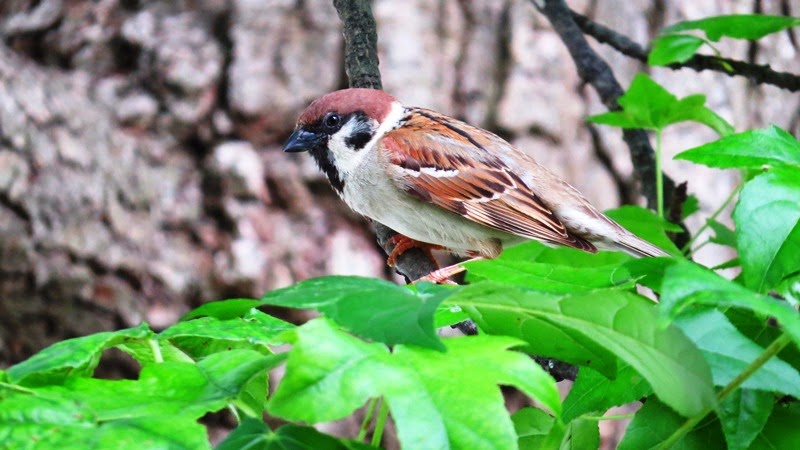
Eurasian Tree Sparrow

hungry?  


In North America, a population of about 15,000 birds has become established around St. Louis and neighboring parts of Illinois and southeastern Iowa. These sparrows are descended from 12 birds imported from Germany and released in late April 1870 as part of a project to enhance the native North American avifauna. Within its limited US range, the Eurasian tree sparrow has to compete with the house sparrow in urban centers, and is therefore mainly found in parks, farms and rural woods. The American population is sometimes referred to as the "German sparrow", to distinguish it from both the native American tree sparrow species and the much more widespread "English" house sparrow,


Eurasian Tree Sparrow in natural setting
                                              Thanks so much to Don&Cheryl for picking me up and helping me get this life bird. This makes the 5th life bird I've gotten with them. Usually we are together down in the Rio Grand Valley of South Texas in March enjoying the sunny warm weather, birding and Mexico!! They have hosted Red&Louise Gambill in early falls on their way to Texas for the winter. They have shown them Eurasian Tree Sparrow, usually in flocks out in the fields getting ready for winter.
BirdTeam6
Art? "Redwood"
Big wood
           
Rampage video game, I'm the Lizard


 We stopped by Laumeier Sculpture Park for some birding and crazy pictures of what we call Art. The redwood sculpture is over 30 feet, all made from one tree log. We drove west on I-44 toward Tulsa, and stopped at another park, that had a auto tour, so we could bird by car, it sure gets hot and humid here in the midwest.  We saw/heard Louisiana WaterThrush, Kentucky warbler, Acadian Flycatcher, Yellow Throated warbler, Common Yellowthroat, and this nice
Red-Headed Woodpecker
This sparrow puts me at #552 for ABA life list, and #293 for BigYear2014. So with that, birding was done, mission accomplished. Now onto the mine dive.

Bonne Terre, MO is about 60 miles south off I-55 towards Memphis, then SR67 southwest. Turns out this little town has  “The Worlds Largest Man Made Caverns”. BONNE TERRE MINES was one of the earliest lead mines in Missouri, and was the worlds largest producer of lead ore. Mining at Bonne Terre began in 1860, and continued until 1962. The mine covers an underground area larger than the town of Bonne Terre, and consists of five levels. The lower three levels are flooded, to form a seventeen mile long illuminated Underground “Billion Gallon Lake” which was filmed and dived by Jacques Cousteau, and is home of the worlds largest inland SCUBA diving resort. The two upper levels of the Mine are lighted and used for one hour guided Walking Tours along the old Mule Trails, and Boat Tours.

Starting platform

Boat ride


Divers coming up, safety spotter on kayak 


Mine Shaft, levels 4&5 are flooded
Ghost stories??

Next up: ????


Thursday, June 19, 2014

Late spring Ohio birding

Well, this is it. It's almost officially summer, the temperature is up, and the birding slows down. By now, you usually make your list of year birds seen so far, and then you start to tackle the individual birds that you've missed for the year. Summer is usually slow, so when you do go out, it's to see specific birds in locations that you know you can see them.  Sometimes though . . . a rarity or lifer may show up.  Keep you eyes and ears peeled.

 So off to the summer chase. One the best locations to bird in central Ohio, is on the far west side, off Broad St./SR40 outside the outer belt. It's call Battelle Darby Metro Park. Really, it comes down to the Teal Trail/Harrier Loop and South Kuhlwein Rd wetlands area. There are lots of birds to see there, including many species of sparrows like Grasshopper, Vesper, Savannah, Henslow, Song, Chipping, Field, and Nelson's. It's a great place to bird. I stopped by on June 8th for the reported nesting pair of Blue Grosbeaks.  When looking for them, you just have to listen for the grosbeak call, and sure enough, right off the Kuhlwein Rd. parking lot, walking south on the bike path . . .

Male Blue Grosbeak

better pic, singing away

A large, vibrantly blue bunting with an enormous silver bill and chestnut wingbars, the male Blue Grosbeak sings a rich, warbling song from trees and roadside wires. He and his cinnamon-colored mate often raise two broods of nestlings in a single breeding season. A bird of shrubby habitats, these richly colored birds can be hard to spot unless you hear them singing first. They are widespread but not abundant across the southern U.S., and are expanding their range.

After that, I looked for the reported Bells' Vireo in the Teal Trail parking lot, but no bird was there. So, I went up to Heritage Park Trial in Hilliard, where the Bells' Vireo have nested the last 2 years, but no luck yet, but I'm sure later this summer I'll hear them singing there. But I did get a Willow Flycatcher 

Willow Empid. singing "fitz-bew"


A small drab flycatcher of wet, brushy areas, the Willow Flycatcher is best identified by its voice. Nearly identical to the Alder Flycatcher; the two species were considered the same until the 1970s.

On Sunday June 15th, I spent the morning chasing warblers and tanagers that I have missed so far this year.  Off the http://birding.aba.org/maillist/OH, there where reports from early June of many nesting warblers at Black Hand Gorge State Park in eastern Licking County. I have never been there, but the pictures looked amazing. I contacted fellow birder Charlie Bombaci for details and a map of the trails. I arrived at 8am, and parked in the lot for the Marie Hickory Trail. I walked south along the gravel road, pass a the first oil containers, and heard the distinct call of the Prairie Warbler
Singing Prairie Warbler
 A tail-wagging yellow warbler with black streaks down its sides, the Prairie Warbler is found in scrubby fields and forests throughout the eastern and south-central United States, not on the prairies. I saw several last year in Florida, but this was my first Ohio species seen in the last couple of years.

From there I drove over to the main entrance/parking lot of the park, and walked down the paved Blackhand trail. At the marker "D", I walked up the Quarry Rim trail into the woods, about 30 feet, I heard the very distinct call "chuuree, chuuree, churee" of the Kentucky Warbler.

Singing male Kentucky
A bird of the deciduous forests of the southeastern United States, the Kentucky Warbler's loud song can be heard far more frequently than the brightly-colored bird can be seen. It stays near the ground and the lower levels of the forest, and nests on the ground. Sure enough, it took me over 30 minutes of chasing this bird around, you could hear it, but seeing it is very very tough. I got lucky and it finally landed in a good spot, enough for me to get this photo.
 So BAMM, I've added three more new year species for the year, bring my BIGYEAR total to #292, with 4 states visited. Not bad so far, my goal is to best 2013's mark of #338. Hopefully with more Ohio summer birding, a Washington trip in October, and maybe an August trip somewhere, I should be able to get 47 more birds.  Enjoy the summer, and keep birding

Next up:  Life Bird chase to St. Louis, MO for a sparrow??


#2025 Big Year in Review

  Happy New Year!!!  2026 , can you believe it? Wow has the time gone by fast.  This post is a recap of the year that was  #BigYear2025 🐦🐦...